
Currently Empty: 0.00₹

How to Reduce Fat With Bodyweight Exercises
You can effectively reduce fat with bodyweight exercises by incorporating progressive overload, consistency, and variation into your workout routine, which will not only challenge your muscles but also boost your metabolism and burn calories even when you’re not actively exercising. By tailoring exercises to your body type and fitness goals, you’ll be able to torch fat and reveal a more toned physique. Stick to it, and you’ll be on your way to unlocking a leaner, healthier you – and there’s more to discover to help you get there.
Key Takeaways
- Consistency and progressive overload are essential for effective bodyweight exercises that reduce fat and build lean muscle mass.
- Exercises that work multiple muscle groups at once, like push-ups, squats, and lunges, can be highly effective for fat loss.
- Increase frequency, duration, or intensity of workouts, or try new exercises to challenge muscles and drive progress towards fat reduction.
- Core strength is essential for functional fitness and overall health, and should be incorporated into a bodyweight workout routine.
- Track workout progress through photos, measurements, or a workout log to stay motivated and see the results of fat reduction efforts.
Building Lean Muscle Mass
As you embark on your fitness journey, one crucial aspect to focus on is building lean muscle mass.
This is because lean muscle plays a significant role in boosting your metabolism, which in turn helps you burn more calories and reduce fat.
When you have more lean muscle, your body becomes more efficient at burning fat, even when you’re not actively exercising.
To promote muscle growth, you need to challenge your muscles through progressive overload, which means gradually increasing the intensity of your workouts over time.
This will signal to your muscles that they need to grow and adapt to the demands you’re placing on them, resulting in increased lean muscle mass and a more toned physique.
Understanding Bodyweight Exercises
You’re likely familiar with the concept of bodyweight exercises, but do you truly understand their benefits and versatility?
These exercises can be tailored to suit your body type, whether you’re lean and athletic or curvy and full-figured. The key is to adopt the right exercise mindset, focusing on progressive overload and consistent practice.
With bodyweight exercises, you can work out anywhere, anytime, without relying on expensive gym equipment. This flexibility is a major advantage, as you can adapt your routine to fit your lifestyle and goals.
Bodyweight Training and Fat Loss: The Terms That Matter
Bodyweight resistance training works on the same principle as any other strength training: you create a
calorie deficit through activity, protect lean body mass with resistance, and let
your basal metabolic rate and non-exercise activity thermogenesis (NEAT) do the
rest of the work across the day. Two other terms are worth knowing because they explain why a short session still
matters. EPOC, or excess post-exercise oxygen consumption, is the elevated oxygen use that follows
hard intervals; it keeps energy expenditure above resting level for a while after you stop. Time under
tension is how long a muscle is loaded during a set, and it is the variable most people accidentally
shorten when they speed up to chase reps. Fat oxidation, the rate at which your body uses stored fat for fuel,
responds to all three.
Where bodyweight training fits best is in the same week as the habits that support it: a daily calorie target
you can actually hold, enough fibre and
protein to stay full, and
sleep long enough to recover.
Effective Exercises for Fat Loss
Many effective bodyweight exercises can help you torch fat and reveal lean muscle.
You’ve likely heard exercise myths claiming that certain exercises, like crunches or leg raises, are the key to fat burning. However, the truth is that any exercise that gets your heart rate up and works multiple muscle groups can be effective for fat loss.
Burpees, jump squats, and mountain climbers are all great examples of exercises that can get your heart pumping and burn calories. Additionally, exercises that work multiple muscle groups at once, like push-ups, squats, and lunges, can also be highly effective for fat burning.
How Many Calories Bodyweight Exercises Actually Burn
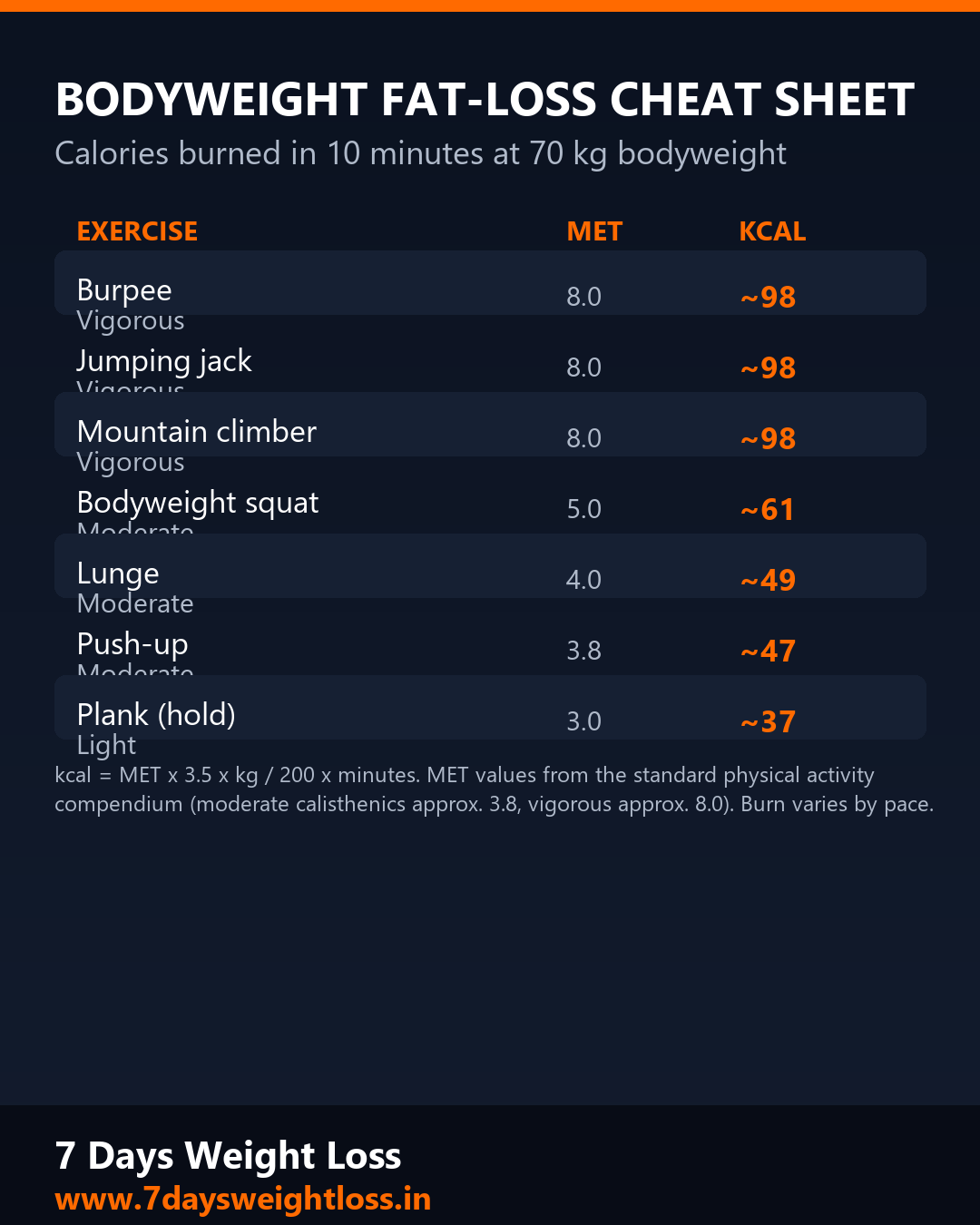
As a rough guide, energy cost is estimated from MET values (the metabolic equivalent of a task), using
kcal = MET x 3.5 x bodyweight in kg / 200 x minutes. The table below is for a 70 kg adult over 10 minutes
of continuous work. Individual burn varies with pace, bodyweight and effort.
| Exercise | Effort | MET | kcal / 10 min | Main muscles |
|---|---|---|---|---|
| Bodyweight squat | Moderate | 5.0 | ~61 | Quads, glutes, core |
| Lunge | Moderate | 4.0 | ~49 | Glutes, quads, balance |
| Push-up | Moderate | 3.8 | ~47 | Chest, shoulders, triceps |
| Plank (isometric hold) | Light | 3.0 | ~37 | Core, shoulders |
| Burpee | Vigorous | 8.0 | ~98 | Whole body |
| Jumping jack | Vigorous | 8.0 | ~98 | Whole body, calves |
| Mountain climber | Vigorous | 8.0 | ~98 | Core, hips, shoulders |
MET values follow the standard compendium of physical activities, where light or moderate calisthenics sit near
3.8 and vigorous calisthenics near 8.0. That is the arithmetic reason a 10-minute circuit of burpees, jump squats
and mountain climbers beats 30 minutes of slow crunches for the same clock time — and why
HIIT-style bodyweight workouts and
core work belong in the same week rather than in place of
each other. If you are starting from a low base, low-impact bodyweight exercises
get you the muscle-protecting part of the equation without the joint load.
Creating a Bodyweight Workout Routine
You’re ready to create a bodyweight workout routine that torches fat and transforms your physique.
First, you’ll need to build strong foundations by mastering essential exercises like push-ups, squats, and lunges.
Then, you can incorporate progressive overload techniques, such as increasing reps or sets, to continue challenging your muscles and driving progress.
An 8-Week Progression You Can Actually Follow
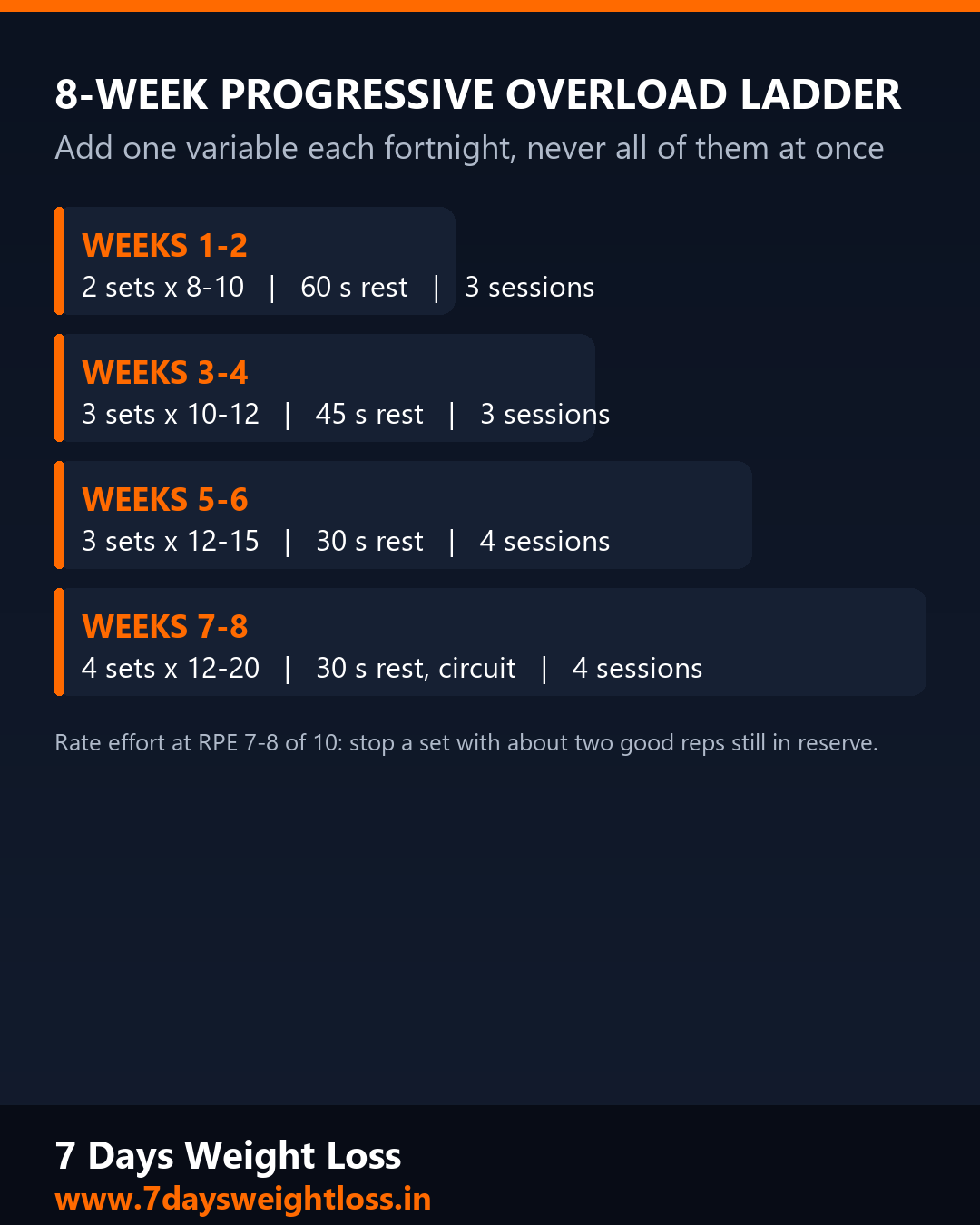
Progressive overload is easiest to apply when the change is written down in advance. Add one set or a few reps
each week, and only move to the harder variation once you can complete every set with two reps left in reserve
(a simple way to rate effort: RPE 7-8 out of 10).
| Weeks | Sets | Reps | Rest | Sessions / week | Change from previous block |
|---|---|---|---|---|---|
| 1-2 | 2 | 8-10 | 60 s | 3 | Learn the movement, full range, slow tempo |
| 3-4 | 3 | 10-12 | 45 s | 3 | Add a set, cut rest |
| 5-6 | 3 | 12-15 | 30 s | 4 | Harder variation (jump squat, decline push-up, pistol squat) |
| 7-8 | 4 | 12-20 | 30 s | 4 | Circuit format, minimal rest, or add a finisher |
Plateaus are the normal result of adaptation rather than a sign of failure, and the fix is a changed variable
rather than more of the same — see overcoming weight loss plateaus.
If strength gains stall while fat loss continues, keep the resistance work and read
how to maintain muscle while losing fat and
the benefits of strength training for fat loss.
Building Strong Foundations
Three key components form the foundation of an effective bodyweight workout routine: consistency, progression, and balance.
You’ll want to establish a regular workout schedule to build consistency, ensuring you’re exercising at the same intensity and frequency each week.
As you progress, you’ll need to challenge yourself by increasing the difficulty of exercises or adding more reps and sets.
Balance is crucial, too, as it ensures you’re working all major muscle groups and avoiding plateaus.
Focus on building core strength, which is essential for functional fitness.
You’ll be able to perform daily tasks with ease and confidence, and you’ll be well on your way to reducing fat with bodyweight exercises.
Progressive Overload Techniques
Now that you’ve built a strong foundation for your bodyweight workout routine, it’s time to challenge yourself further.
To take your fitness to the next level, you’ll need to incorporate progressive overload techniques into your routine. This means gradually increasing the intensity of your workouts by adding more reps, sets, or weight over time.
As you get stronger, your muscles will adapt, and you’ll need to challenge them further to achieve muscle fatigue. Progressive resistance is key to achieving this.
Try adding more challenging variations of exercises, increasing the duration of your workouts, or decreasing rest time between sets. By pushing yourself harder, you’ll continue to see results and torch that unwanted fat.
Increasing Metabolism With Bodyweight Exercises
You’re about to discover how bodyweight exercises can kickstart your metabolism.
By incorporating specific exercises into your morning routine, you’ll boost your metabolism and set yourself up for a day of fat-burning.
High-intensity interval training (HIIT) is another key strategy you’ll learn to supercharge your metabolism and take your weight loss to the next level.
Boost Morning Metabolism
Starting your day with bodyweight exercises is a powerful way to kick-start your metabolism, getting it firing on all cylinders from the get-go.
By incorporating exercises into your morning routine, you’ll boost your fat-burning potential and set yourself up for a day of weight loss. Try adding a short circuit of squats, lunges, and push-ups to your morning routine.
This will get your heart rate up and burn calories, even after you’ve finished exercising. As you continue to move throughout the day, your metabolism will remain elevated, burning more fat and calories.
High-Intensity Interval Training
Twenty minutes of high-intensity interval training (HIIT) with bodyweight exercises can be a game-changer for your metabolism.
You’ll burn calories during and after your workout, boosting your metabolism and torching fat. However, many people make HIIT mistakes that hinder their progress.
One common error is inconsistent workout scheduling. You can’t do HIIT once a week and expect significant results.
Aim to do HIIT three to four times a week, with at least one day of rest in between. This will allow your body to recover and adapt to the intense exercise.
Benefits of Bodyweight Exercises for Weight Loss
By incorporating bodyweight exercises into your fitness routine, you’ll be surprised at how effective they can be in helping you shed those extra pounds.
As natural fat burners, bodyweight exercises get your heart rate up and keep it there, maximizing calorie burn. You’ll start to notice the numbers on your weight scales decreasing, and your body toning up.
Bodyweight exercises also improve your metabolism, helping your body to burn fat more efficiently. Plus, they’re convenient and cost-effective, allowing you to work out anywhere, anytime.
With consistent effort, you’ll be on your way to achieving your weight loss goals in no time.
Tips for Maximizing Fat Loss With Bodyweight Exercises
You’ve already experienced the benefits of bodyweight exercises for weight loss, now it’s time to take your fat-burning potential to the next level.
To maximize fat loss, it’s essential to incorporate workout variety into your routine.
This will keep your muscles guessing and prevent plateaus.
- Change your exercise routine every two weeks to avoid adaptation and keep your muscles challenged.
- Incorporate high-intensity interval training (HIIT) to boost your metabolism and burn more calories.
- Focus on compound exercises like burpees, squat jumps, and mountain climbers that work multiple muscle groups at once.
- Increase your workout frequency to 3-4 times a week to accelerate fat loss.
Overcoming Plateaus With Progressive Bodyweight Exercises
Since you’ve been pushing your body with consistent bodyweight exercises, it’s likely that you’ve reached a point where your progress has slowed down or stagnated. This is normal, and it’s not because you’re not working hard enough. It’s because your body has adapted to your workout routine, and you need to challenge it in new ways.
To overcome this plateau, you need to incorporate progressive bodyweight exercises into your routine. This means increasing the difficulty of your workouts by changing variables such as:
| Consistency Challenges | Workout Variety |
|---|---|
| Increase frequency or duration | Try new exercises like single-leg squats or pistol push-ups |
| Increase intensity or weight | Incorporate isometric holds or plyometric exercises |
| Change your rest time or tempo | Focus on different muscle groups or planes of motion |
Frequently Asked Questions
How to Measure Fat Loss When the Scale Stalls
Bodyweight flatters neither good nor bad weeks: it moves with water, sodium, glycogen and digestion. Track two
or three measures and look at the direction over four weeks, not the number on any one morning.
| What to measure | How often | What it tells you | Watch out for |
|---|---|---|---|
| Waist circumference (navel level) | Every 2 weeks | Change in abdominal and visceral fat | Measure at the same time of day, relaxed |
| Bodyweight (same scale, morning) | Weekly average | Overall trend, not daily noise | Single-day spikes are usually water |
| Progress photos (same light, same pose) | Every 4 weeks | Posture and shape change the scale hides | Different lighting fakes progress |
| Reps and rest achieved | Every session | Real performance gain = muscle retained | Speeding up reps to hit a number |
| Waist-to-height ratio under 0.5 | Monthly | Simple risk marker for visceral fat | Not a substitute for clinical advice |
Logging the sessions is what keeps the progression honest; any of the
weight-loss tracking apps or a paper notebook is enough.
Visceral fat, the fat stored around the organs, responds to the same activity but is worth following on its own
measures — see how to reduce visceral fat naturally and
foods that help reduce belly fat.
Getting Help With a Bodyweight Fat-Loss Plan
Everything on this page can be done at home, and consistency will take most people a long way. Where coaching
changes the outcome is in the middle: matching a calorie target and a protein intake to your own body, adjusting
the progression when the scale stops moving, and picking the version of an exercise that your knees, shoulders or
back will tolerate for eight weeks rather than three. That is the work 7 Days Weight Loss does at its weight
loss centres, alongside its herbal range and its review panel.
If you would like a plan built around the routine you already have, start with a
free weight loss consultation, see
how the programme works and read what clients say before you
decide. You can also browse more weight loss articles on the same subject.
Can I Do Bodyweight Exercises if I’m Overweight or Obese?
You can still do bodyweight exercises if you’re overweight or obese, but you’ll need to set modified expectations and realistic goals, focusing on progress over perfection, and listening to your body to avoid injury.
How Long Does It Take to See Results From Bodyweight Exercises?
You’ll start seeing results from consistent bodyweight exercises in 4-6 weeks, but patience is required; it takes time for your body to adapt, and progress may be slow, but with regular effort, you’ll notice changes, and consistency matters to achieve your goals.
Can I Do Bodyweight Exercises if I Have Joint Problems?
You can still do bodyweight exercises with joint problems, but you’ll need to modify your routines to reduce stress on your joints. Look for low-impact alternatives that focus on strengthening your core and improving flexibility.
Do Bodyweight Exercises Work for Weight Loss in Older Adults?
As you age, you’ll face age-related changes, including muscle mass loss, but don’t worry, bodyweight exercises can still help you lose weight and maintain muscle tone, even in older adulthood, as long as you’re consistent and modify exercises to suit your needs.
Can I Combine Bodyweight Exercises With Cardio for Faster Results?
You’re wondering if combining bodyweight exercises with cardio boosts results. Absolutely! Try high-intensity interval training (HIIT) cardio sessions, then incorporate progressive overload into your bodyweight exercises to push yourself harder and see faster fat loss.
Conclusion
You’ve made it to the final step of your bodyweight exercise journey! By now, you’ve built lean muscle mass, mastered effective exercises, and created a workout routine that’s tailored to your needs. Remember to keep challenging yourself with progressive exercises, stay consistent, and focus on proper form. With time and dedication, you’ll be burning fat and revealing the lean, toned body you’ve always wanted.
Related Reading on Fat Loss and Bodyweight Training
- Best time of day to exercise for weight loss
- Walking vs running for fat loss
- Effective home workouts for fat loss
- Resistance band exercises for fat loss
- Yoga poses that promote fat burning
- Dance workouts for burning calories
- How to boost metabolism naturally
- Managing stress to prevent weight gain
- Staying hydrated for weight loss
- Setting realistic weight loss goals
- Staying motivated during a weight loss journey
- Meal planning for weight loss
- Reading nutrition labels
- 7 bodyweight exercises for rapid weight loss results
- 3 bodyweight exercises for rapid weight loss
- What are the best exercises for weight loss
- How to use circuit training for fat burning
- Why high-intensity cardio burns fat fastest
- Why strength training beats cardio for fat loss
- 7 best morning exercises to melt belly fat
- 5 Pilates routines for fast weight-loss results
- How many exercises per muscle group for weight loss
- How to track macros for fat loss
- How to create a sustainable diet plan
- How long it takes to see weight loss
- Fat loss programmes at 7 Days Weight Loss
Products That Support a Bodyweight Fat-Loss Plan
Exercise builds the calorie deficit; the products below are what clients add alongside it when they want a structured herbal push in the same direction. Each product page lists the pack size, the price and how to use it.
- 7 Days Weight Loss programme – the short structured starting point for a first round of fat loss.
- 5 kg body weight loss in one month – the monthly plan for a steady, measured result.
- Weight Loss Treatment – 10 kg result – the longer supervised treatment for a bigger target.
- CASSIA Tummy Reduce Ayurvedic Powder – the powder clients pair with core, plank and crunch work.
- CASSIA Herbal Tablet – the everyday tablet form.
- CASSIA Body Toxins Removal – the detox pack often taken before a fat-loss round.
You can browse the whole CASSIA herbal range in the shop, including the cholesterol, blood-pressure and diabetes powders.
More Weight-Loss Guides Worth Reading
- Home workout routines for women over 40
- Quick office workout routines for weight loss
- Effective fat-loss exercises for weight-loss success
- How to use a food diary for weight loss
More From 7 Days Weight Loss
- About CASSIA and its herbal range
- About 7 Days Weight Loss
- Frequently asked questions
- Contact the clinics
- Shop all CASSIA products
Book a Free Weight-Loss Consultation
Talk to a coach before you start. If you want your own numbers worked out – a calorie target, a protein target and an eight-week progression you can actually keep – book a free weight-loss consultation with the 7 Days Weight Loss team.
Phone: +91 9994952278
Email: [email protected]
Also see: contact and clinic details, common questions and what clients say.